

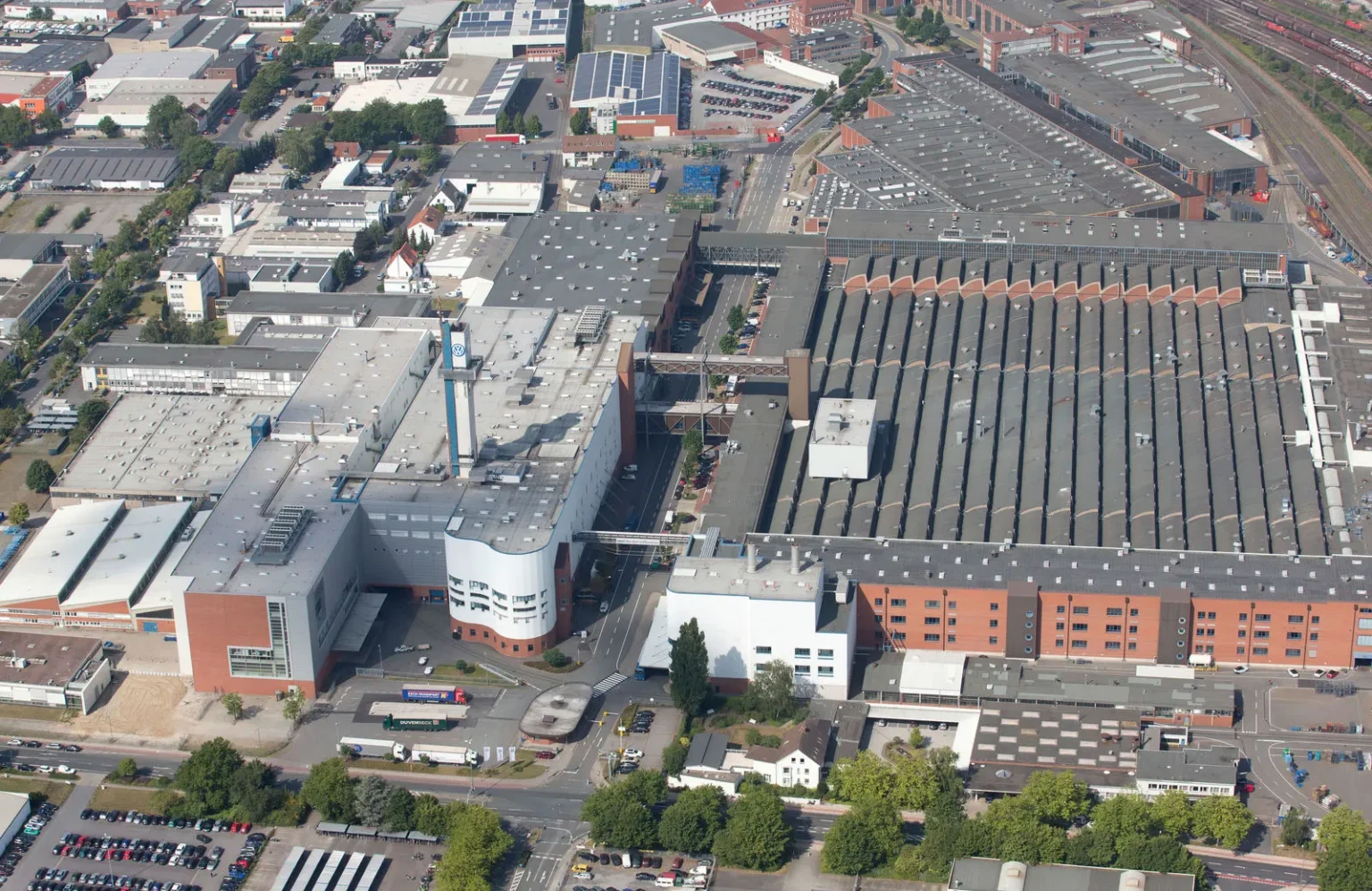
Volkswagen just turned a closing car plant into a defense manufacturing site. The equipment didn’t change – what changed was the question management asked about it.
Key takeaways
- Two factories at the same utilization rate can be worth completely different amounts. What matters is whether unused capacity has an economically attractive alternative use.
- Stranded capacity has no attractive next use. Optional capacity does. A utilization dashboard cannot tell them apart.
- Europe is proving the point in real time: car plants, rail plants and auto parts plants are being converted to defense production because their capabilities outlived their original products.
- Before you cut capacity, map its capability: materials, tolerances, processes, tooling, certifications and skills.
- The trend in utilization matters more than today’s number. The earlier you see it falling, the more options you keep.
What is the difference between stranded and optional capacity?
Stranded capacity is unused capacity with no economically attractive alternative use, usually because the equipment is too specialized or too expensive to retool. Optional capacity is unused capacity that could be redirected to another product, customer or market at an acceptable return. Both look identical on a utilization report. Economically, they are opposites.
The distinction matters because unused capacity is not automatically a problem. Capacity with no attractive alternative use is the problem.
What is happening at Volkswagen’s Osnabrück plant?
Volkswagen has a capacity problem. Its CEO has won approval for a restructuring that brings total planned job cuts to 100,000, with four German plants in Emden, Zwickau, Hanover and Neckarsulm facing possible closure between 2031 and 2034. The pressure is real: first quarter 2026 net profit fell 28% year over year, and China sales dropped 20% in the quarter.
The traditional response to excess capacity is familiar: close the plant, sell the machine, eliminate the shift, write down the asset.
Osnabrück took a different path. On September 7, 2026, Volkswagen, the State of Lower Saxony and Aurelius Capital announced a deal to shift the site from small series and special vehicle production to making systems and components for air defense in Germany and Europe. The initial anchor project would involve Rafael Advanced Defense Systems. Vehicle production at the site was already set to end by summer 2027 under a 2024 decision.
The outcome matters to people, not just balance sheets. Labor officials say the deal could preserve about 1,400 of the site’s 1,800 jobs.
Aurelius put its reasoning plainly. The buyer said Osnabrück offers “something that cannot be built from scratch”: experience with demanding products, precise processes and well-coordinated teams.
Walk the Osnabrück floor before the deal and it wouldn’t have looked like a defense contractor, it would have looked like a car plant winding down, machinists finishing T-Roc Cabriolet orders on tooling nobody wanted anymore. What made a buyer show up was never visible on a walk-through of the assembly line itself. It was in the skills, the process discipline and the quality systems built into everyone still standing on that floor.
Same physical plant. Different market. Different customer. Different economics.
That raises the question every manufacturer with underused equipment should ask: is this capacity truly stranded, or have we simply not found its next use?
Osnabrück is not an isolated case
Across Europe, factories built for one market are finding a second life in another:
| Plant | Original purpose | New purpose |
| Volkswagen, Osnabrück | Small series and special vehicles | Air defense systems and components |
| KNDS, Görlitz | Alstom railcar production | Leopard 2 hulls, turret housings, Boxer modules |
| Rheinmetall, Berlin | Pierburg engine components | 155mm artillery shell casings |
| Rheinmetall, Neuss | Automotive components | Skyranger turrets, protected truck cabins |
| Renault, Le Mans | Automotive assembly | Chorus drone assembly |
The speed is the lesson. Just over a year after taking over the Görlitz plant, KNDS had converted more than half of its 70,000 square meter production area and expects to employ 400 people there by the end of 2026. KNDS credits the site’s highly specialized workforce for how fast the transformation moved.
Rheinmetall designed its Berlin and Neuss sites as hybrid plants that keep the ability to produce civilian products — optional capacity by design: the factory keeps more than one future open.
Renault’s case may be the clearest. French defense authorities approached the carmaker for capabilities long established in automotive, including industrialization, mass production, quality control and shorter lead times, with drone capacity potentially reaching 600 units a month within a year.
None of these buyers wanted the car or the railcar, they wanted what the factory already knew how to do.
Two factories at 60% utilization
Imagine two factories, both running at 60% utilization. On a dashboard, they look the same.
Factory A has equipment built for a product in permanent decline. Retooling would cost nearly as much as new equipment. There are few adjacent products it can make economically.
Factory B has flexible equipment, skilled operators, available tooling and certifications that could support several adjacent products with modest investment.
Both have 40% unused capacity. Factory A may have stranded capacity. Factory B may have optional capacity. They are completely different economic situations wearing the same number.
This isn’t a niche question. U.S. manufacturing capacity utilization was 75.7 percent in August 2026, 2.5 points below its long run average, according to the Federal Reserve. A lot of American capacity is sitting idle. The real question is how much of it is stranded and how much is waiting for the next use.
The five layers of manufacturing capacity
Manufacturers often talk about capacity as a single number. It isn’t.
| Layer | What it means |
| Installed Capacity | What the equipment could theoretically produce |
| Available Capacity | What the operation can actually produce after labor, maintenance, material, changeovers, quality, downtime and actual cycle time |
| Uncommitted Capacity | What remains after existing and future customer commitments |
| Optional Capacity | Unused capacity that could be redirected to another attractive product, customer or market |
| Stranded Capacity | Capacity with no economically attractive alternative use today |
A factory can have enormous Installed Capacity and very little valuable capacity. Or it can look underused while sitting on a real strategic opportunity.
Economic Capacity, in the three-layer version of this model, was a single sliding score. The five-layer version splits that judgment into two concrete decisions: Optional Capacity is the share of your uncommitted capacity with an attractive alternative use, and Stranded Capacity is the share without one.
Why a machine’s current use is not its only use
Once an asset is installed, management thinks about it in terms of its original purpose. This machine makes Product A. This line serves Customer B. This facility supports Market C.
The machine does not know any of that. The machine knows materials, dimensions, tolerances, processes, speeds, temperatures, tooling and technical capabilities.
The original business case may have been Product A. The underlying capability may be much broader.
A machine’s current use is not necessarily its only use.
Osnabrück is the extreme version. The strategic value was never really the specific vehicle the plant built. It was the skilled labor, industrial equipment, quality systems, engineering, supplier relationships, logistics, production knowledge and physical infrastructure inside it.
Change the question and the value of the asset changes.
How the Gap can hide opportunity
At TransLution, we talk a lot about the Gap: the distance between what the system believes and what is actually happening on the floor.
Usually we treat it as risk. Syspro says the material exists; the operator cannot find it. The routing says 18 minutes; reality takes 24. The machine looks available; maintenance knows otherwise.
But the Gap can hide opportunity too. The ERP describes a machine by what it currently makes. The floor can reveal what it is actually capable of making. Those are not the same thing.
So manufacturers should ask what capabilities exist inside their factory that their commercial systems do not know how to sell.
The Big Five: five power questions for any idle capacity
TransLution’s Big Five of Operational Truth give you a structured way to decide whether capacity is stranded or optional.
1. What do you have?
Not how many machines. What capabilities do those machines actually possess? Which materials, processes, tolerances, tooling, certifications, operator skills and available hours exist? The more precisely you understand the asset, the more accurately you can see its alternatives.
2. Where is it?
Where does unused capacity physically sit? One facility may be constrained while another has idle equipment. One line may be overloaded while a similar line sits quiet. A manufacturer can have excess capacity and a capacity shortage at the same time.
3. Who is using it?
Which customers, products and orders consume the capacity today, and how profitable are they? A machine at 90% utilization is not automatically better than one at 60%. If the first runs low margin work and the second could serve a more valuable market, utilization alone points management the wrong way.
4. Is it where you thought it would be?
This is where assumptions meet reality — whether demand developed as expected, whether the mix changed, whether actual cycle time matches the standard, and whether the market the asset was built for actually grew. The factory was built on assumptions. Operational Truth tells you whether they still hold.
5. What is it costing you?
Count depreciation, maintenance, labor, utilities, floor space, working capital and opportunity cost. Then ask the other side: what could this capacity earn if it were redeployed? That single question moves the conversation from cost reduction to capital allocation.
How do you evaluate underused equipment before cutting capacity?
Start with capability, not cost. Describe each asset by the materials it processes, the dimensions and tolerances it holds, its speed, its tooling and its available hours. Then match that profile against existing products, adjacent products, new customers, other industries and supply shortages elsewhere. Only then decide whether to repurpose, maintain, sell or close.
When utilization falls, management sees cost, and cost leads to reduce, consolidate, close. Sometimes those are the right decisions. They should not be the first question. The first question is what else you could make with what you already have.
That requires a different description of the factory. Not: Machine 17 produces Product A. But: Machine 17 can process these materials, at these dimensions, to these tolerances, at this speed, using this tooling, with this much available capacity — that’s the foundation of capacity repurposing.
Capacity has two markets: inside and outside the factory
Knowing a machine has 2,000 available hours is half the problem. The other half is knowing who needs what those hours can produce.
Line 4 has 28% available capacity. Useful.
Three existing customers are sourcing parts elsewhere that Line 4 could make. Better.
An adjacent industry is short of capacity in a process your equipment already performs. Now it is an opportunity.
The question shifts from how to eliminate the excess capacity to how to monetize it. That’s exactly the question European defense buyers asked when they looked at Osnabrück, Görlitz and Le Mans.
Why Operational Truth matters beyond the shop floor
Operational Truth is usually treated as an operations issue. It also informs sales, pricing, capital allocation, product strategy, customer selection, M&A and market expansion.
Imagine giving your commercial team a continuously updated view of available manufacturing capabilities, true capacity, cost per productive hour, conversion requirements and economic thresholds, and then connecting it to market demand.
The factory becomes part of the growth engine. That is far more useful than another utilization report.
The Capacity Economics test
Not every idle machine deserves a second life. Optionality only has value if the economics work.
For each alternative use, understand conversion cost, conversion time, available capacity, expected demand, customer concentration, cycle time, material requirements, labor, margin, working capital and return on invested capital. Then compare four paths:
| Option | When it tends to win |
| Repurpose | Capabilities transfer, conversion cost is modest, demand exists nearby |
| Maintain | Demand dip looks temporary and holding cost is low |
| Sell | The asset is worth more to another operator than to you |
| Close | No attractive alternative use exists; the capacity is truly stranded |
That is Capacity Economics. The goal is not to keep every asset alive. It is to make the best economic decision about each asset while you still have more than one option.
Why the utilization trend matters more than today’s number
We recently wrote about Operating Runway: knowing how much inventory you have is useful, but knowing how long it will last is better.
Capacity has its own clock. Picture utilization sliding from 72% to 66% to 59% to 51%. Each quarter looks manageable on its own. The trajectory is the warning.
At 72%, you may still have time to find another customer, develop another product, retool, move work, enter an adjacent market or repurpose the facility. At 30%, the financial pressure may already have made the decision for you.
Volkswagen made its Osnabrück call in 2024, three years before the last vehicle was due to roll off the line. That runway is what made a buyer, a partner and a defense anchor project possible.
Predictability = Visibility + Control
Visibility tells you the capacity is becoming underused. Control comes from seeing it early enough to decide what that capacity should become.
That depends on floor data you can trust. If the ERP holds standard cycle times while the floor runs slower, and scrap and downtime are captured at the end of the shift from memory, you cannot calculate true available capacity, let alone price it for a new customer. Capturing labor, material and job transactions as work happens is what turns a guess into a capability map.
Stranded or optional?
Volkswagen is facing this question at enormous scale. Every manufacturer has its own version: a machine running below plan, a shift no longer full, a product declining faster than expected, a customer that moved production, a warehouse with empty space, a line whose business case no longer holds.
The easy conclusion is “we have excess capacity.” That may be true. It is not yet a decision.
Ask instead:
- What capability do we actually have?
- What is its true available capacity?
- What does it cost us?
- What else could it produce?
- Who else needs that capability?
- What would conversion require?
- What return could it create?
Then ask: is this capacity stranded, or is it optional?
Before you close the line, sell the machine or cut the shift, find out whether the factory you already paid for can do something more valuable next.
Want to know which of your capacity is stranded and which is optional? Start with TransLution’s 5 Question Audit, or request a custom demo to see real time floor data flowing into Syspro.
Frequently asked questions
Stranded capacity is production capacity that has no economically attractive alternative use. It usually involves highly specialized equipment serving a product in permanent decline, where retooling would cost close to what new equipment would.
Optional capacity is unused capacity that can be redirected to a different product, customer or market at an acceptable return. It typically comes from flexible equipment, transferable skills, existing certifications and modest conversion costs.
No. Low utilization is a problem only when the unused capacity has no attractive alternative use. A line at 60% with transferable capabilities can be a growth option, while a line at 90% running low margin work can be destroying value.
Capacity repurposing is redirecting existing equipment, lines or facilities to new products, customers or markets instead of closing them. Recent examples include Volkswagen’s Osnabrück plant moving to air defense work and KNDS converting a former Alstom rail plant to armored vehicle components.
Map each asset by capability rather than current product: materials, dimensions, tolerances, speeds, tooling, certifications and available hours. Then compare that profile against adjacent products and markets, and test each option for conversion cost, time, demand and margin.
Defense buyers need capacity quickly, and automotive and rail plants already have skilled workforces, mass production experience, quality systems and supplier networks. Converting an existing plant is often faster than building one from scratch.
Available capacity is what a plant can actually produce after real constraints like labor, downtime and changeovers. Uncommitted capacity is what is left of that after existing and planned customer commitments.
Sources and further reading
Global Banking and Finance Review (Reuters), September 25, 2026: Explainer: The road ahead for Volkswagen’s restructuring
Army Technology: Volkswagen Osnabrück site set for redevelopment into air defence hub
CNN Business: Volkswagen strikes deal to turn car plant into defense facility
BusinessDay (Reuters): VW plant deal could save 1,400 jobs as Osnabrück shifts to defence
Yahoo Finance: Volkswagen job cuts: 100,000 jobs and 4 plant closures planned
The Defense Post: KNDS Converts Former Rail Factory Into Armored Vehicle Production Hub
Defence Industry Europe: KNDS expands Görlitz defence production site
Militarnyi: Rheinmetall to convert two plants for defense needs
TurDef: Volkswagen Plant Signals Europe’s War Economy Shift
Federal Reserve Board: G.17 Industrial Production and Capacity Utilization
TransLution Software: Your Inventory Report Tells You What You Have. It Doesn’t Tell You When Production Stops.
TransLution Software: You Can’t Cut What You Can’t See
TransLution Software: The Big Five of Operational Truth [confirm URL]
TransLution Software: Predictability = Visibility + Control [confirm this is the right link — used the Lancewood case study URL as best guess]
