You Can Have Too Much Inventory and Still Not Have What You Need
American Eagle just discounted excess stock while still not having what shoppers wanted.
Manufacturers hit the same wall with raw materials and components every day.

American Eagle just discounted excess stock while still not having what shoppers wanted.
Manufacturers hit the same wall with raw materials and components every day.

Why manufacturers need to connect inventory, consumption, and time before a shortage becomes a production problem.

Cost cutting and cost removal are not the same thing. Cutting a supplier price or freezing headcount can lower an expense line without eliminating the operational waste that created it. Real cost reduction starts with Operational Truth: knowing exactly what is happening on the floor, where reality has drifted from plan, and what that drift is costing you before you decide what to cut.

Most operational problems are more complicated than they first appear. Inventory is wrong. A production order is late. A pallet cannot be found. A machine is waiting for material. A customer shipment misses its date. A quality issue appears. The instinct is usually to ask for more data, but after years of working with operating teams, I have found that many complicated problems reduce to five remarkably simple questions. We call them the Big Five of Operational Truth.

When an unplanned disruption shuts down a manufacturing system, the first priority is obvious. During the outage, physical work in the real world continues while system records stay frozen in time, creating a dangerous truth gap between what actually happened on the floor and what the system believes happened.
This article explores why that gap puts inventory counts, production records, quality status, and traceability at risk even after systems come back online. We lay out five critical questions manufacturers must answer before restarting production safely, how to prepare in advance, and how TransLution helps manufacturers close that gap and restore confidence in their operations after any disruption.

As Corinthian Furniture’s business grew, their existing inventory system couldn’t keep pace. By implementing TransLution in phases over two years, the company improved warehouse control, introduced innovative RFID-driven work-in-progress tracking, and built stronger traceability across its operations.
TransLution isn’t just for manufacturing and warehousing — it’s a powerful platform for transforming processes in any industry.
At OAPL, a leading Australian orthotic and prosthetic provider, clinical documentation had become a major operational challenge.

Bakels Orley, a manufacturer and distributor of a wide range of bakery ingredients and services, has further expanded their use of TransLution Software to integrate with SYSPRO Manufacturing Operations Management (MOM).

Bakels Orley, a company that manufactures and distributes a wide range of ingredients and application solutions, has successfully implemented TransLution Software across their entire facility.

Accurate, real-time data is the cornerstone of improvement strategies in manufacturing and production.
The importance of accurate data in manufacturing is indisputable. In today’s climate of fierce competition, manufacturers must continually search for ways to improve productivity and customer support. In order to maximize results, companies must utilize their data in a strategic fashion, finding the strengths and weaknesses and looking for ways to improve.
While having accessible manufacturing data is no doubt beneficial, simply capturing data is not enough. Not having said data available and on hand when it is needed significantly reduces its usefulness. Imagine how many times during a day opportunities for improvement might be squandered if decision makers don’t have access to the right information.

TrafFix Devices, Inc. is a 34-year-old manufacturer of traffic control devices and crash attenuation products that save lives on the world’s highways. Based in Southern California, their products are designed and engineered to meet the highway requirements of countries all over the world.
With a distribution network spanning the United States, Canada, Australia, New Zealand, Europe, South Africa, Mexico and the Middle East, TrafFix requires streamlined productivity, high stock accuracy and most importantly, efficiency. On evaluation, TransLution™ Software ticked all the boxes – a comprehensive, configurable solution using barcode scanning and RF functionality from the point of receipt through to put away, transfers, manufacturing, order processing, pick and pack and dispatch with speed and accuracy.


Airborne Systems is the world’s most trusted resource for parachute design and manufacturing. With the expertise of highly skilled engineers, craftsmen and aerospace and defense professionals, they have a foundation of nearly 100 years of designing, developing and fabricating a diverse range of products for the U.S. Department of Defense (Army, Air Force, Navy, Marines and Coast Guard) and their international allies. Due to the nature of their business it is critical that Airborne effectively track labor throughout their manufacturing process. However, they were using manual time and job cards that were then manually captured in spreadsheets by back-office staff. The process was inefficient, slow, and cumbersome and resulted in dated information available in their SYSPRO ERP software. It became clear to Airborne that this system needed to be improved.
At IB McIntyre innovation is a process that involves thinking about their business every day and looking for opportunities to improve. Jonathan Dawson, Commercial Director, says “In today’s world a business must be like a chameleon constantly adapting to changes in the environment.”
This client manufactures Mesh Steel Reinforcing for use in the construction industry. It receives coils of wire as raw material and draws these coils or parts of these coils through various machines to produce the finished products that it sells.
This client manufactures and repairs large mining equipment. The repair sector requires that spare parts are kept on-site. As a result, the environment is a combination of a standard warehouse and a complex manufacturing setting. The company’s largest challenge is to manage the conflicting requirements of parts for its manufacturing business with demand from the repair and sales arm, particularly if there is a supply crunch on critical parts.
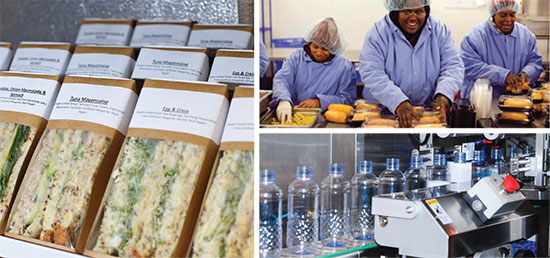
This company manufactures food products on behalf of a leading South African retailer. The products range from packaged snacks such as muffins and sandwiches through to pre-prepared meals for home consumption. Products of this type have a particularly short shelf life which can be measured in terms of a few days rather than weeks or months.
| Cookie | Duration | Description |
|---|---|---|
| cookielawinfo-checkbox-analytics | 11 months | This cookie is set by GDPR Cookie Consent plugin. The cookie is used to store the user consent for the cookies in the category "Analytics". |
| cookielawinfo-checkbox-functional | 11 months | The cookie is set by GDPR cookie consent to record the user consent for the cookies in the category "Functional". |
| cookielawinfo-checkbox-necessary | 11 months | This cookie is set by GDPR Cookie Consent plugin. The cookies is used to store the user consent for the cookies in the category "Necessary". |
| cookielawinfo-checkbox-others | 11 months | This cookie is set by GDPR Cookie Consent plugin. The cookie is used to store the user consent for the cookies in the category "Other. |
| cookielawinfo-checkbox-performance | 11 months | This cookie is set by GDPR Cookie Consent plugin. The cookie is used to store the user consent for the cookies in the category "Performance". |
| viewed_cookie_policy | 11 months | The cookie is set by the GDPR Cookie Consent plugin and is used to store whether or not user has consented to the use of cookies. It does not store any personal data. |